

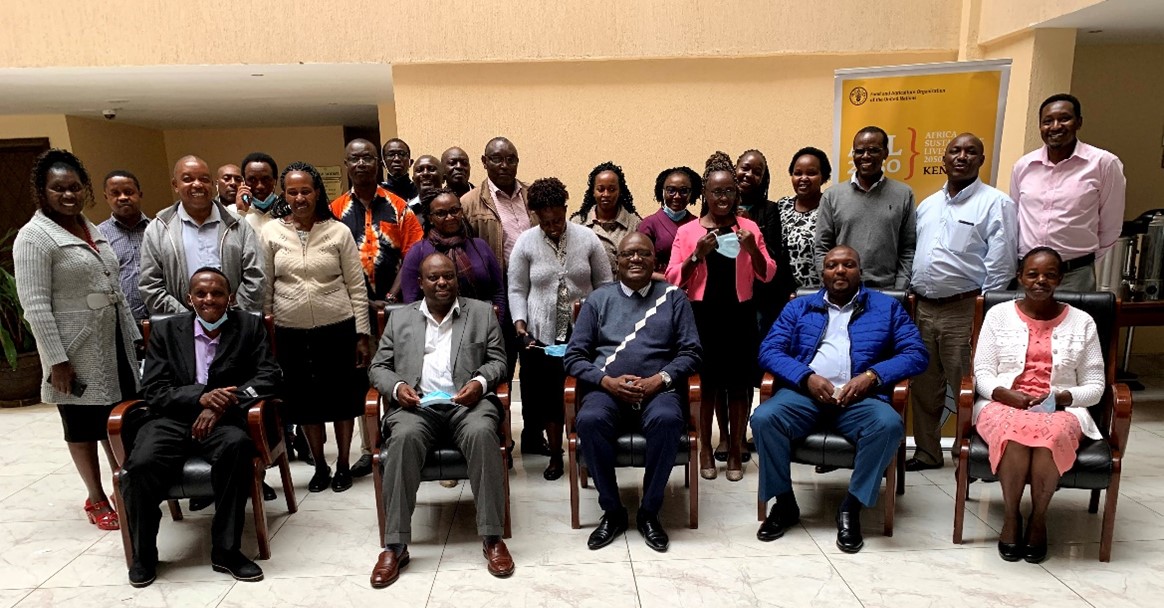
Towards the end of June 2021, the Food and Agriculture Organization of the United Nations (FAO) through the USAID funded project Africa Sustainable Livestock 2050 brought together county executives and animal health officers from Kiambu and Nairobi counties for a two-day policy dialogue meeting.
This dialogue meeting aimed to explore how to improve the provision of services to poultry businesses (SMEs) – from farmers through processors to retailers – to ensure they adopt good biosecurity practices.
It consisted of county executive committee members, chief officers, county directors of veterinary services and frontline animal health officers in the two counties. The moderators were Stephen Gikonyo and Joy Kiplamai, both from FAO, and Dr. Simon Ndiritu and Isaac Kigen, lecturers at Strathmore University Business School and lead researchers in several pilot studies FAO is conducting in the two counties.
This meeting is part of the ongoing dialogue between county animal health officers and poultry farmers to enable the enforcement of existing livestock sector policy and legislation on biosecurity. The first meeting involving poultry slaughter operators was conducted in March 2021 and involved discussion on evidence compiled from two key studies conducted by FAO and Strathmore University Business School in late 2020.
Dr.Asoka Itur, Chairperson of Africa Sustainable Livestock 2050 National Steering committee spoke to the importance of these policy dialogue meetings. “I am excited that ASL2050 of FAO is facilitating policy implementation discussions not only with the technical staff but also with county executives who are in charge of policy enforcement. This is a positive move as this is where resource allocation decisions are made, and with clear understanding of the underlying challenges, it is far easier to arrive at practical solutions,” he said.
During this second meeting with public animal health officers and county executives, the dialogue focused on how the county governments can facilitate the adoption of the prioritized good animal biosecurity practices by private actors.
Speaking during the meeting, Joseph Kamau, County Executive Committee Member, Agriculture, Livestock and Fisheries Department, Kiambu county, noted that implementation of biosecurity policies have been a challenge. “I am glad that this meeting is discussing implementation of policies on the ground, which has been a great challenge. I pledge to support legislation and budget allocation toward animal health services,” he said.
It further reviewed the good practices prioritized by slaughter node actors and agreed that the actions proposed if implemented would contribute to a large extent reduction of public health threats.
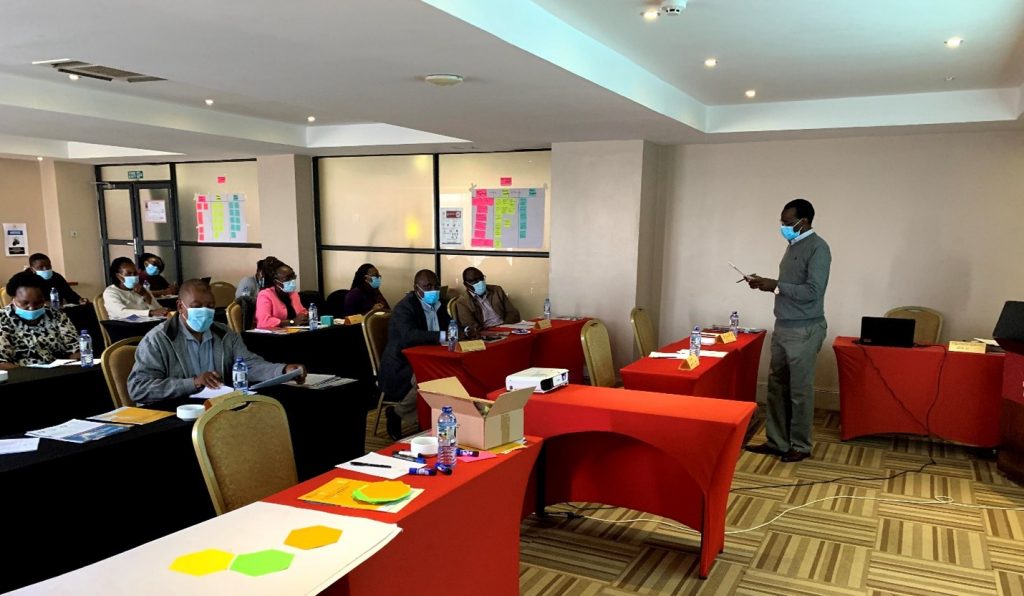
These proposed actions were:
- Defining and developing poultry slaughter slabs (on farm) standards and sharing them with broilers farmers who wish to invest in slaughter facility
- Customizing the meat control rules to suit their local conditions and scale of operation
- Advising and providing designs for poultry slaughter slabs,
- Sensitizing actors and consumers on risks of handling or consuming un inspected poultry meat
- Inspecting and licensing the slaughter facilities to ensure they meet minimum standards
- Providing centralized slaughter facilities through the Public-Private Partnerships concept
- Facilitating cooperation with relevant county departments and units for provision adequate budgets for county veterinary public health programs
- Introducing and sensitizing actors on new slaughter technologies ( mobile facilities)
- Demonstrating the benefits of conducting meat inspection in relation to reducing threats
- Enhancement of sustainable poultry businesses
The next steps in the dialogue will seek to systemize the actions proposed by the private actors and public actors to find consensus on how public animal health officers can best support the private actors to adopt the prioritized good practices. FAO with support of Strathmore University will then facilitate the two counties to implement the selected actions on the ground, and assess and document the adoption of the good practices and impact on business profitability and public health.
By Dr. S. Wagura Ndiritu
Vous souhaitez partager un article ? Écrivez-nous à sbscommunication@strathmore.edu
Partagez cette histoire, choisissez votre plateforme !
Votre voyage vers l'excellence commerciale commence ici. Abonnez-vous dès aujourd'hui et soyez à la pointe de l'innovation et du leadership.








 English (United States)
  English (UK)
  French