

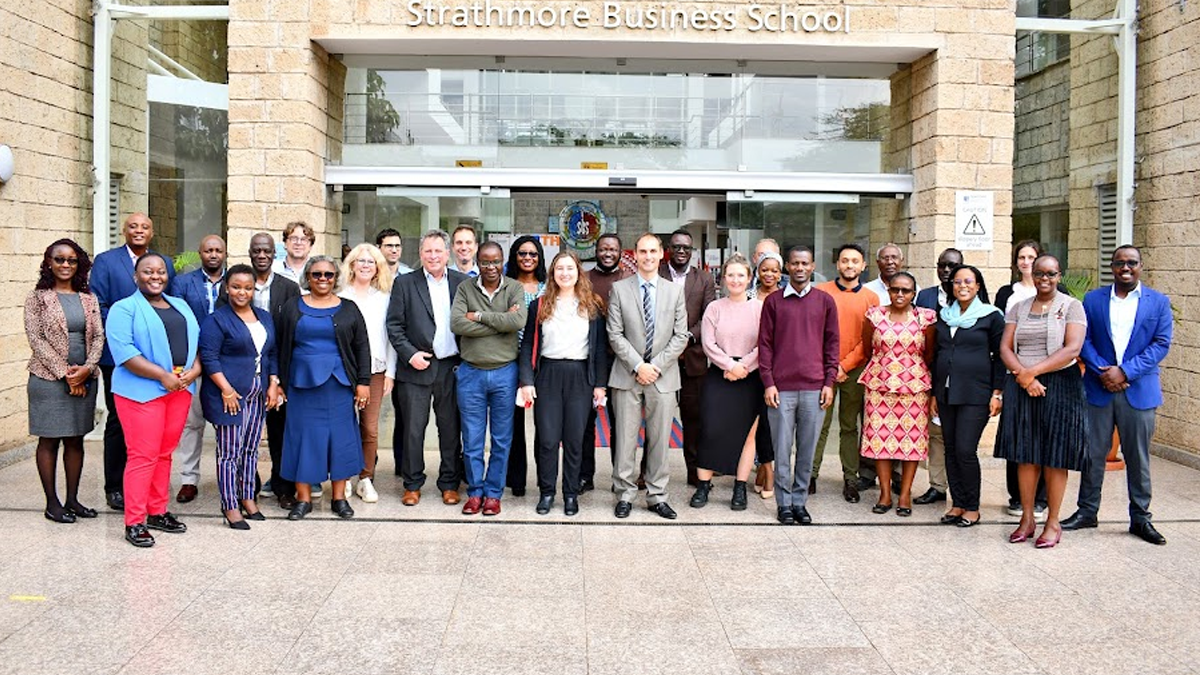
The Digital Innovations and Diagnostics for Infectious Diseases in Africa (Didida), Project, had its official kick-off meeting on the 2nd and 3rd of November 2022 at Strathmore University Business School (SBS).
Didida is a project funded by the European Union and the United Kingdom Research and Innovation (UKRI) fund and aims to develop a better diagnostic tool for some of the main causes of death in rural areas of Africa such as severe respiratory infections, HIV/AIDS, diarrhoea, malaria, or tuberculosis. These five diseases account for nearly 80% of the total burden of infectious diseases and kill more than 6 million people annually in Sub-Saharan Africa.
The project aims to develop reliable, low-cost and mobile phone-connected tests to help detect multiple infectious diseases and non-communicable diseases (NCD) in sub-Saharan Africa. Further, it aims to invest in digital health infrastructure and train a new generation of African experts to meet the health needs of the continent.
“Didida is a multidisciplinary project that combines health research, socio-economic studies and digital innovation leading to new impacts in clinical diagnostics and engineering. The project has a strong African involvement with an ambition to strengthen capacity across PhD training in institutes and organisations in Sub-Saharan Africa. Our aims include the creation of a user-friendly and low-cost digital diagnostic tool integrated into mobile phone platforms to improve healthcare. The project will also impact the decentralization of health care in Europe and the United Kingdom.” said Jonathan Cooper, Professor of Engineering at the University of Glasgow and principal investigator on the Didida project.
Diagnostics linked to mobile phone platforms
Didida is a mobile phone-linked digital diagnostic solution which is suitable for areas with limited health infrastructure. The IT builds upon the wide adoption of mobile health and payment systems within sub-Saharan Africa. Didida will integrate a mass-manufacturable paper-based test, a mobile application for data transmission and a connected platform for data collection, analysis, and reporting.
A user-friendly and low-cost diagnostic tool
The project is based on the development of DNA and molecular tests that are affordable and can be used without specialized training. By detecting multiple diseases all at once the tool is much more cost effective and efficient compared to a regular diagnostic process. The initiators, a consortium of 14 partners, have already made significant advances in recent years creating simple tests capable of identifying diseases in the area, including malaria and Hepatitis C in Kenya.
Data to empower health workers and decision-makers
Health managers and policymakers will have access to aggregated collected data to make informed decisions. All technologies are based on open-source, transparent and easily deployable solutions such as m-Health for the mobile data application and the already-existing health data infrastructure DHIS2.
The consortium plans to evaluate the implementation of its multiplex diagnostics in the context of ongoing digital health system strengthening efforts in Western Kenya.
Strengthening research in infectious diseases and NCDs in Africa
Next to the development and roll-out of the diagnostic tool, the project plans to strengthen African research capacity through the funding of 16 doctoral fellowships in Africa. These Early-Stage Researchers will participate in dedicated training sessions on all technical aspects of the program, whilst cohort events will provide this new generation of researchers with the diagnostic tools to fight leading diseases in Africa.
The Didida projects run until September 2027 with a funding of nearly 6 million euros from the European Union’s Horizon Europe program and 2 million euros from the UKRI fund. The consortium includes 14 partners from eight countries: Kenya, Senegal, Tanzania, Uganda, the United Kingdom, France, the Netherlands, and Italy. The partners include; École de commerce de l'université de Strathmore, Amsterdam Institute for Global Health & Development (AID), African Population and Health Research Center (APHRC), Biostructures and Biosystems National Institute (INBB), Global Access Diagnostics (GADx), Innotrope, Institut Pasteur, Pasteur Institute of Dakar, Kenya Medical Research Institute (KEMRI), Kilimanjaro Clinical Research Institute (KCRI), Medical Research Council (MRC)/UVRI and the Ugandan Ministry of Health.
Par Juliet Hinga
Vous souhaitez partager un article ? Écrivez-nous à sbscommunication@strathmore.edu
Partagez cette histoire, choisissez votre plateforme !
Votre voyage vers l'excellence commerciale commence ici. Abonnez-vous dès aujourd'hui et soyez à la pointe de l'innovation et du leadership.







 English (United States)
  English (UK)
  French