

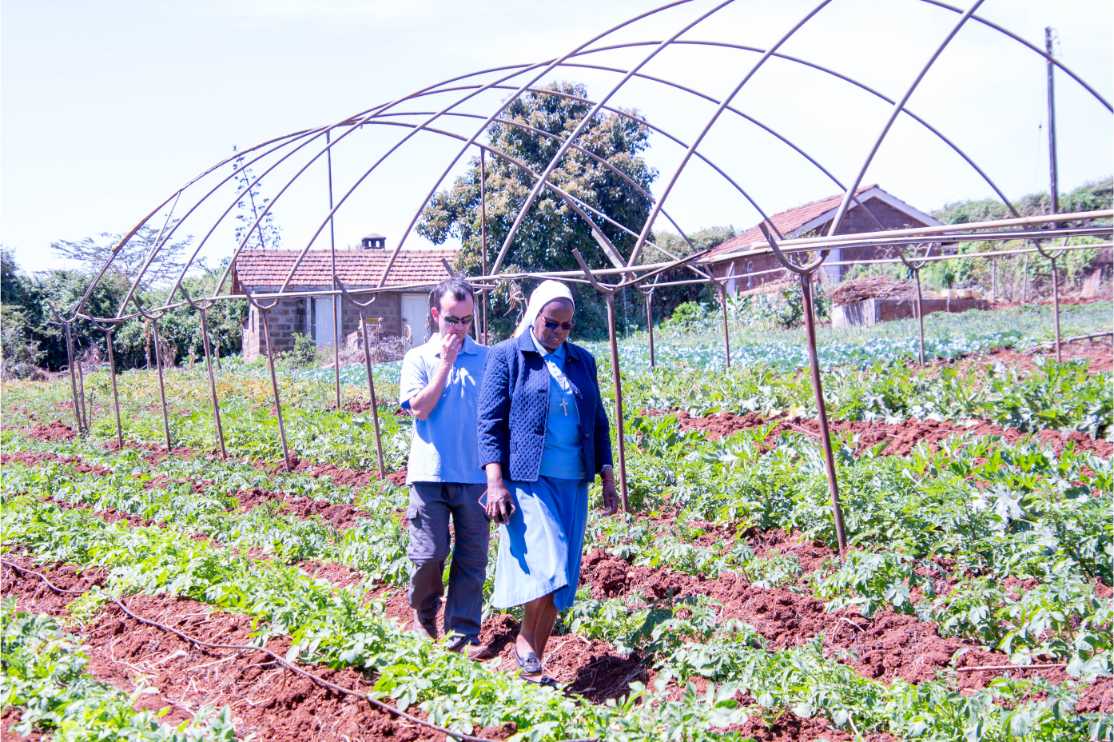
In a world where faith-based organizations are increasingly called upon to address societal needs, how can nuns—women dedicated to spiritual service—also become effective leaders of schools, hospitals, and farms? This question lies at the heart of the Sisters Blended Value Project (SBVP), a groundbreaking initiative at Strathmore University Business School in collaboration with the Association of Consecrated Women in Eastern and Central Africa (ACWECA) and generously supported by the Conrad B. Hilton Foundation. SBVP equips Catholic sisters with the skills to transform their social ministries into sustainable social enterprises.
Recently, we sat down with Agnes Ruoro, a leadership faculty and coach at Strathmore University Business School, specializing in self-awareness, self-mastery, and leadership development. Her work with the SBVP highlights the intersection of faith, leadership, and sustainable business practices.
What Does Leadership Look Like in Faith-Based Institutions?
The SBVP began with a simple yet profound question: How are faith-based institutions structured, and how can we tailor leadership training to meet their unique needs? Through careful exploration, the program revealed that congregations operate much like corporations, with clear hierarchies and roles. At the top is the Mother Superior, the equivalent of a CEO, supported by councillors and delegate superiors. Below them are administrators, financial teams, and project leads—nuns who hold formal managerial positions.
How Did the Program Adapt to Different Countries?
The SBVP has been implemented in Kenya, Zambia, Tanzania, and Uganda each with its own unique challenges and opportunities. What differences did we notice among the sisters in these countries? In Kenya, the sisters operated larger, more established social enterprises, often competing with corporate organizations in sectors like education and healthcare. In Zambia, farming and schools were more prominent, while Uganda shared similarities in healthcare and education.
Despite these differences, the sisters faced a common challenge: balancing their charism with the need to run sustainable enterprises. This required the program to adapt its delivery to address the specific needs of each country while maintaining a unified curriculum.
Why Was Coaching a Game-Changer?
One of the most celebrated aspects of the SBVP is the coaching component. While classroom learning provided the theoretical foundation, coaching bridged the gap between theory and practice. Sisters were tasked with identifying projects aligned with their congregation’s mission, such as expanding a hospital or starting a new social enterprise. For example, one congregation embarked on a bee-rearing project. They quickly realized the need for tree planting to support the bees, trained over 100 women as beekeepers, and coordinated efforts across multiple locations. This project highlighted the importance of collaboration, resource management, and stakeholder engagement—skills they had learned in class but applied in real-time through coaching.
How Did the Sisters Balance Charism and Business Practices?
A recurring challenge was reconciling the sisters’ spiritual charism with the demands of running a business. For instance, a congregation focused on serving the destitute had to navigate the dilemma of providing free services and charging fees to sustain their enterprise. This friction was particularly evident when lay employees, who did not share the same spiritual mission, were involved in the social enterprises. To address this, some congregations developed training programs for lay employees to align them with the organization’s values. This ensured that the charism was not only understood by the nuns but also embodied by those working alongside them.
What Role Did Self-Awareness Play in Leadership Development?
A key component of the program was the Insights Discovery Assessment, which helped sisters understand their personalities and leadership styles. One sister shared how the assessment helped her realize why she felt bored in structured meetings, leading to better collaboration with her colleagues. Another sister leading a borehole project in Molo applied her learning on stakeholder management, resource allocation, and legal processes to navigate challenges like environmental risks and permit acquisition.
The SBVP has demonstrated the transformative power of leadership development in faith-based organizations. By equipping sisters with the skills to lead sustainably, the program has strengthened the sisters´ social enterprises and also amplified their ability to serve their communities.
Share This Story, Choose Your Platform!
Your journey to business excellence starts here. Subscribe today and be at the forefront of innovation and leadership.


Conrad N. Hilton Foundation
The Conrad N. Hilton Foundation foresees a world in which improving the human condition is a shared and sustainable goal. “Love one another, for that is the whole law,” Conrad Hilton wrote in his will. The peoples of the world “deserve to be loved and encouraged—never to be abandoned to wander alone in poverty and darkness.” That is our resolve.







 English (United States)
  English (UK)
  French