


“If the Sisters hadn’t taken me in, I’d probably still be on the streets, maybe worse.”
“I learned how to make and sell detergents. Now I run my own business and take care of my baby.”
“Before, I had no dreams. Today, I’m a certified hairdresser and I’m saving to open a salon.”
One by one, the young women stood to speak, some in tears, others composed with quiet pride, as they shared how the Sisters of Emmanuel had fundamentally transformed their lives. At the Emmanuel Skills Centre, they found more than just education; they discovered dignity, skills, and the courage to start anew.
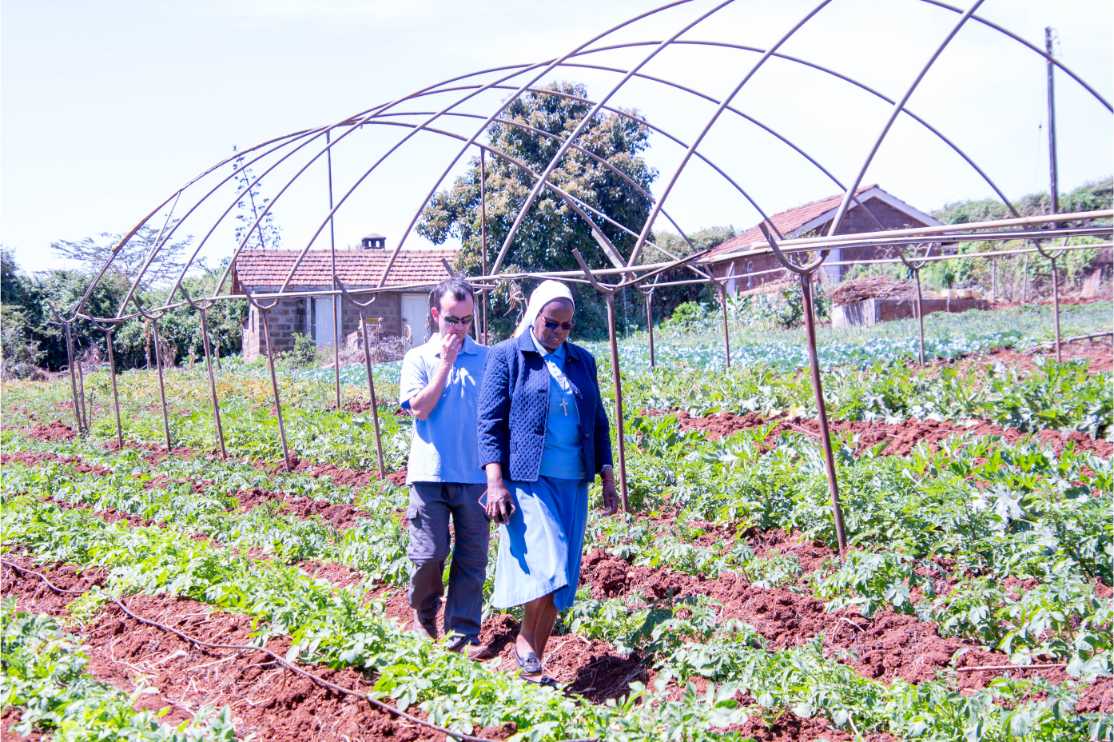
Their testimonies were shared during a visit by the Conrad N. Hilton Foundation to the Emmanuel Skills Center on 9th June 2025 in Maragua, Murang’a County, Kenya. The Emmanuel Skills Center is a faith-based vocational training and social services organization. At the heart of its story is a bold experiment in sustainability. In 2020, as the COVID-19 pandemic forced more girls out of school and into vulnerable situations, the Sisters of Emmanuel, a local Catholic congregation founded in 1989, stepped in. They launched a program to train school dropouts and young single mothers in practical skills such as beadwork, tailoring, baking, and digital literacy. However, running the program required more than goodwill, and donations alone could not sustain it. Thus, the Sisters turned to an unexpected solution: poultry farming.
The Emmanuel Broilers Project, a-a thriving 3,000-bird poultry farm was born after the Sisters of Emmanuel underwent training through the Sisters Blended Value Project (SBVP). What began as a post-training initiative is now a vital engine powering the Emmanuel Skills Center. The broiler project follows a well-structured model: 25% of the proceeds pay school fees for needy girls, 25% project contribution supports the congregation’s needs , and 50% is reinvested into growing the social enterprise. Today, the project sustains 11 jobs within the Maragua community and beyond, provides full scholarships, and has helped launch 10 graduate-run micro-enterprises through startup kits.
Emmanuel sisters proudly notes that their poultry project has become a trusted supplier to Quality Meat Packers (QMP), thanks to rigorous quality control and a skilled team. “We’ve reduced bird mortality and improved turnaround. Every cycle is an opportunity to educate more girls,” she says. But this success didn’t happen overnight. “We had to move from surviving to sustaining,” reflects Sr. Nancy Nyambura, one of the beneficiaries of the SBVP, an initiative funded by the Conrad N.Hilton Foundation and implemented by Strathmore Business School in collaboration with ACWECA. “The training helped us shift our mindset. We’re not just giving; we’re building.”
The Hilton Foundation delegation, led by Sr. Jane Wakahiu, Associate Vice President of Program Operations and Head of the Catholic Sisters Initiative, was visibly moved by the impact of the Sisters’ work. Addressing the young women, Sr. Jane shared, “A dream is an imagination of what we desire in life.” She recounted the story of Mr. Conrad Hilton, the visionary who built a global hotel empire without ever letting go of his belief in charity as a supreme virtue. With heartfelt conviction, she urged the girls to dream boldly, reminding them that with purpose and courage, they too can lead and inspire transformation.
In a powerful moment of collective affirmation, Dr. Angela Ndunge, Principal Investigator at SBVP, unveiled a newly published case study booklet, stating, “As Africans, we do a lot, but we don’t document. Through Strathmore University Business School, SBVP is working to change that narrative.” She challenged the young women in the room to give back, emphasizing that discipline, foresight, and long-term investment are essential ingredients for building lasting legacies and urging them not to see themselves just as beneficiaries but as future changemakers.
Sr. Rosemary Ndege, an alumna of the SBVP program, reflected on the growing ripple effects of the initiative; improved record-keeping, thoughtful reinvestment strategies, and stronger partnerships with local service providers, including boda-boda (Motor cyclists) riders and food vendors. “The impact goes beyond these walls,” she noted.
But, perhaps the most effective measure of success is found in the lives of the girls themselves. Many arrived from backgrounds marked by alcoholism, poverty, or early pregnancy. At the Emmanuel Skills Center, they found more than vocational training; they found a family, complete with daycare, counseling, and mentorship. “We walk with them, not ahead of them,” said Sr. Lina Wanjiku, the congregation’s Superior General. “We want them to rise, not just recover.”
Visiting Kenya for the first time were members of the Hilton Foundation team: Ian de Guzman, Louis Franco, and Vardges Markosyan, who celebrated their 10-year anniversaries with the Foundation. Their visit to the Emmanuel Skills Centre was not just symbolic; it was a powerful and deeply moving celebration of a decade of service and impact. As the delegation departed, emotion lingered in the air. In Maragua, a single broiler chicken may live for only six weeks, but its impact fuels dreams that will last a lifetime.
Article by Alex Okoth
Share This Story, Choose Your Platform!
Your journey to business excellence starts here. Subscribe today and be at the forefront of innovation and leadership.


Conrad N. Hilton Foundation
The Conrad N. Hilton Foundation foresees a world in which improving the human condition is a shared and sustainable goal. “Love one another, for that is the whole law,” Conrad Hilton wrote in his will. The peoples of the world “deserve to be loved and encouraged—never to be abandoned to wander alone in poverty and darkness.” That is our resolve.






 English (United States)
  English (UK)
  French