

As sports events scale globally, their environmental, economic, and social footprints grow exponentially.To address these pressing challenges, the Strathmore Business School (SBS) Sports Hub has joined forces with Sportainable – a think tank committed to sustainable sport across the world.
In the first of the Webinar series on Sports and Sustainability, Sportainable represented by Tervel Zwjatkow looked to pioneer research, dialogue, and education on sports sustainability across Africa and beyond. Tervel Zwjatkow is an international sports event manager, sports sustainability expert, environmental researcher, and former competitive karate athlete from Bulgaria.
Our ongoing collaboration critically examines how modern mega-events, such as the just-concluded 2026 FIFA World Cup spanning 16 host cities across three countries, test planetary and societal limits. Staging large-scale sports requires balancing three core pillars: Planet, People, and Prosperity.
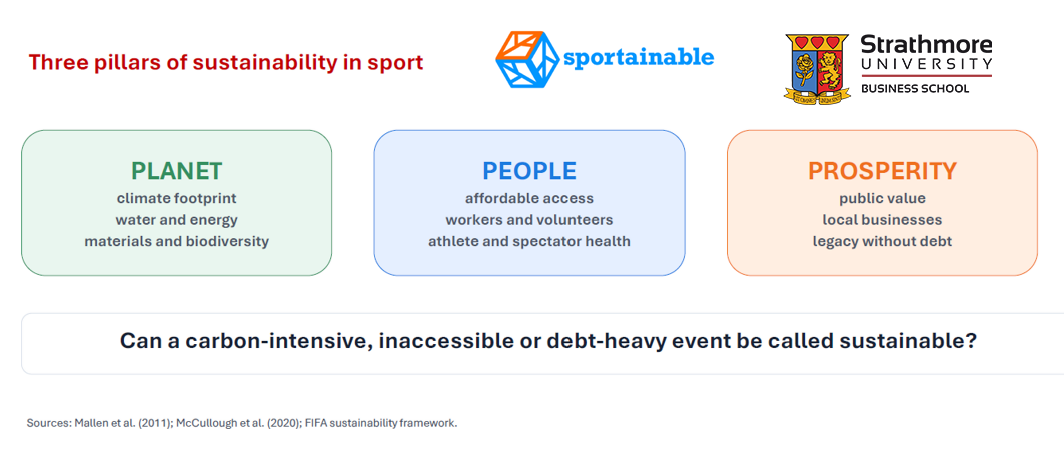
According to the World Economic Forum Sports for People and Planet Report 2026, securing a sustainable future for athletics requires a coordinated approach that transforms the industry’s infrastructure, urban footprint, and investment priorities. This is achieved by championing resource stewardship through the transition of venues and supply chains to circular, renewable, and low-waste operations; integrating sport into urban design to build active cities filled with accessible green spaces and walkable community facilities; and catalyzing purpose-driven capital to direct public and private investments toward grassroots participation, health-centric programs, and sustainable infrastructure rather than purely financial entertainment yields.
Spectator and team transport remain the largest contributors to greenhouse gas emissions, where long-distance air travel heavily inflates a tournament’s carbon footprint. Simultaneously, escalating ticket prices, intense heat stress on athletes, and massive venue investments pose severe challenges to public value and community access.
Through this partnership, Sportainable and Strathmore University is advocating for a vital paradigm shift: “right-sizing” events to fit host environments rather than forcing local communities into long-term debt and unsustainable infrastructure expansion.
The convergence of major sporting events and environmental stewardship represents a critical shift toward global climate action, as demonstrated by the groundbreaking model of the Glasgow 2026 Commonwealth Games. By redefining the hosting framework to prioritize a low-carbon, circular economy, the event proved that elite international competitions can minimize their ecological footprint while maximizing community value.
A primary practical example of this commitment was Glasgow’s decision to avoid new construction entirely, staging all 10 sports within an eight-mile compact corridor of existing infrastructure, such as the EDF Scotstoun Stadium. Furthermore, the event broke historical ground by running 100% of its competition venues entirely on zero-carbon renewable energy sourced directly from the Scottish Grid. This experience provides a highly scalable blueprint for future sports governance, proving that sustainability can be seamlessly integrated into high-stakes athletic entertainment.
Sustainable event management demands compact regional host selection, train-first mobility networks, the reuse of existing multi-purpose venues, and equitable access for local fans. Ultimately, climate protection is athlete protection.
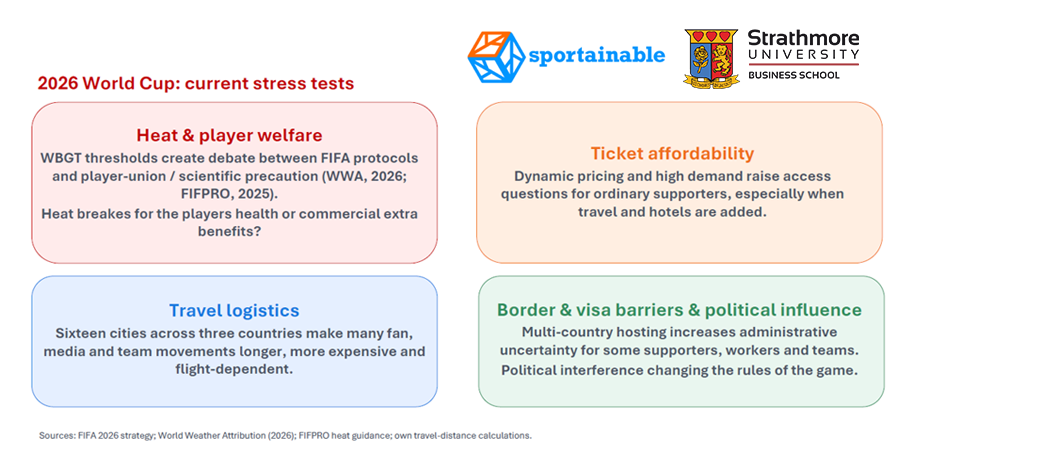
Together, the SBS Sports Hub and Sportainable are dedicated to developing actionable frameworks, policy insights, and academic training for sports executives, venue managers, and policy leaders. By embedding sustainable routines into institutional sports governance, we ensure that the games we love deliver lasting social value within planetary boundaries. We invite the sporting community and, closer to home, the SU/SBS community to join us as we pave the way toward a low-emission, inclusive, and climate-resilient future for local and global sport.
Article by Dr. Raymond Mutura, Richard Wanjohi and Tervel Zwjatkow
Share This Story, Choose Your Platform!
Your journey to business excellence starts here. Subscribe today and be at the forefront of innovation and leadership.





 English (United States)
 English (UK)
 French