

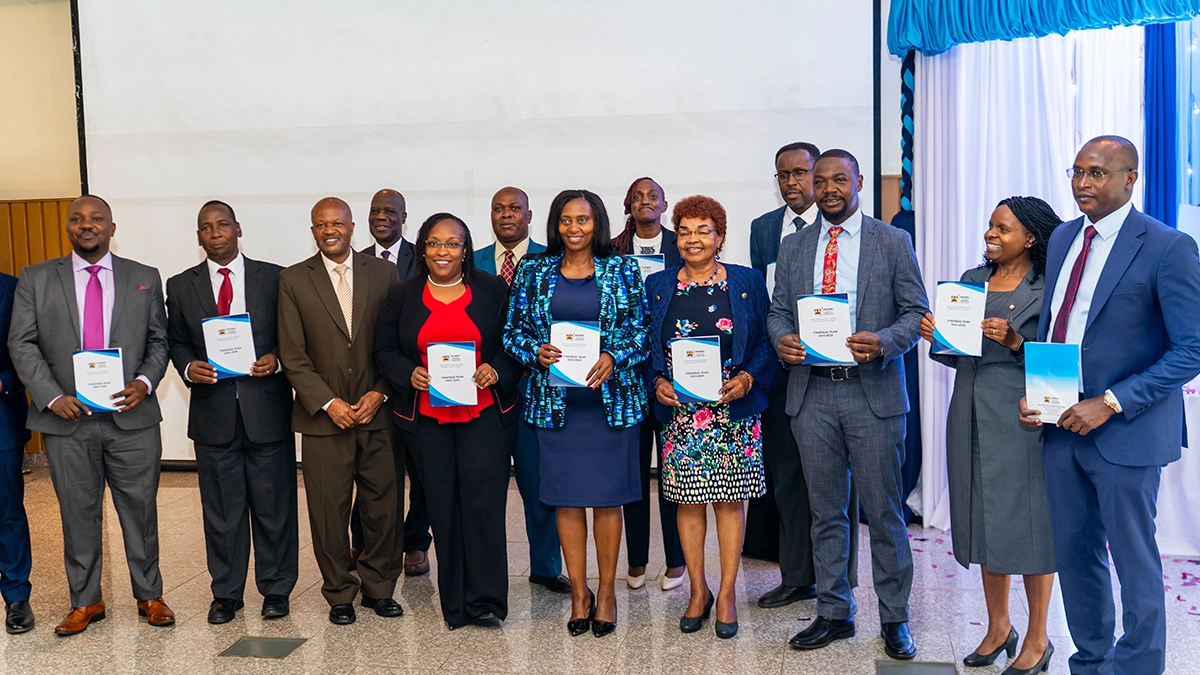





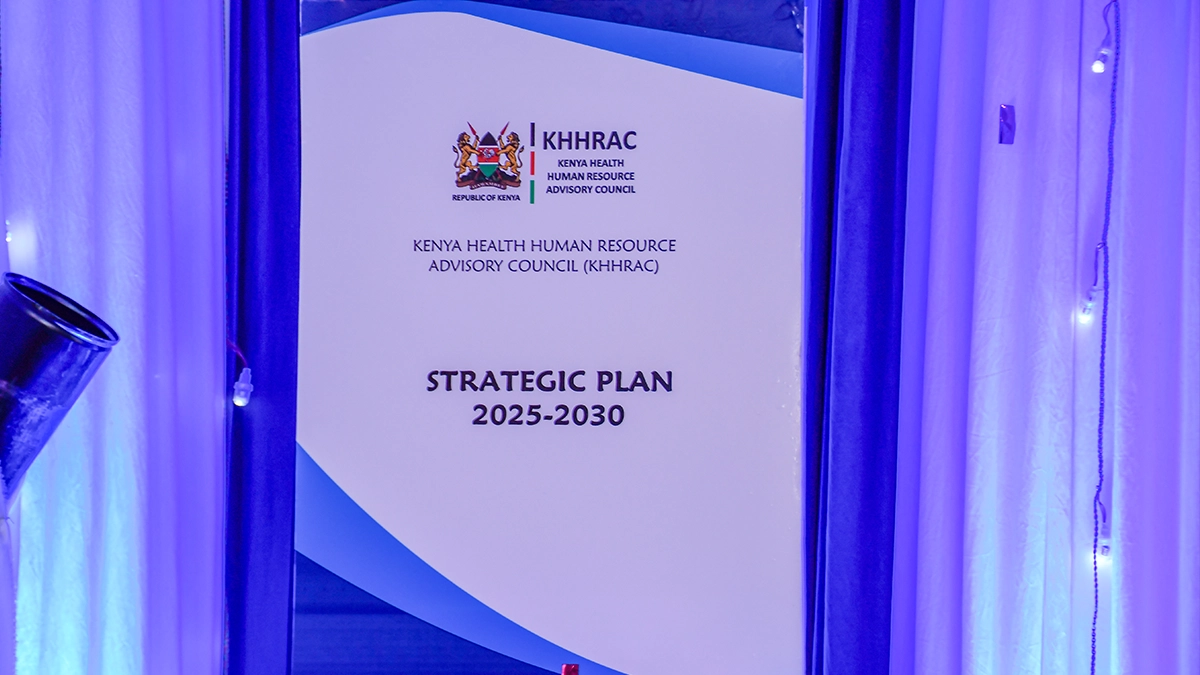

As Kenya intensifies efforts to build a resilient and future-ready healthcare workforce, the Kenya Health Human Resources Advisory Council on Thursday, 7th May 2026, officially unveiled its 2025-2030 Strategic Plan during a high-level stakeholder meeting held at the Strathmore University Business School.
The event was well-attended, convening key stakeholders within the Human Resource for Health (HRH) landscape, including senior government officials, development partners, county representatives, regulators, representatives from healthcare workers unions, student representatives, as well as healthcare professionals in academia, policymaking, and public and private practice alike.
The unveiling ceremony began on a high note with rousing remarks from the host, Strathmore University Business School’s Executive Dean Dr. Caesar Mwangi, as well as the KHHRAC Board Chairperson, Prof. Francis Wafula. Dr. Mwangi lauded the Council’s efforts to tackle the healthcare workforce crisis, noting that our continent was in dire need of HRH planning policies that are Africa-led and informed by local realities.
Dr. Wafula additionally acknowledged the challenges healthcare workers have faced since promulgation of the 2010 Constitution, which devolved healthcare functions to the counties without accounting for mechanisms to manage the workforce to ensure seamless service delivery to citizens across the country. He assured attendees that the Council was committed to fulfilling its mandate, stating that, in its short three-year lifespan, KHHRAC had managed to set up its organisational structures, HR instruments, financial manuals, as well as securing physical office premises that will be ready for occupation by July 2026.
The Chief Guest, Principal Secretary, State Department for Public Health and Professional Standards at the Ministry of Health, Ms. Mary Muthoni Muriuki, emphasized that a dignified and equitably distributed healthcare workforce is the backbone of Universal Health Coverage and access to quality healthcare for all citizens nationwide. She underpinned the government’s support in ensuring underserved communities are equipped with specialists, urging healthcare workers to take advantage of these fully-sponsored opportunities to advance their skills. “Only remember that after you are trained you must come back to serve the communities for which you were trained,” she added.
Spotlight on Health Workforce Governance and System Gaps
A running theme throughout the day was the uneven distribution of the healthcare workforce, largely driven by fragmented HRH planning frameworks. Urban centres continue to attract a disproportionate share of healthcare workers, leaving rural communities with limited access to basic care and forcing many patients to travel even longer distances for specialised treatment. For example, Ms. Muthoni remarked on this disparity in the nursing field, stating that some counties had nursing professionals up to 15 times the national nursing density, and yet with the current HRH structures, such disparities are difficult to address.
The KHHRAC Strategic Plan seeks to address these challenges by restructuring the HRH planning ecosystem and creating a seamless experience for workers, from pre-entry (training and internship) and entry (licensing and deployment) to existence (remuneration, motivation, promotion, and mobility) and exit. Acting CEO KHHRAC, Dr. John Kihama, affirmed the Council’s commitment to the 17-point plan that resulted from the first-ever National Dialogue on Healthcare Workforce Reform, held in October 2023 (dubbed the “Kericho Declaration”), stating that the remaining 12 points of the plan (five were already fulfilled) have been incorporated in this Strategic Plan.
“The Healthcare Workforce is Coping, but Fragile”
These were Dr. Loice Cushny Wanjiru Kaigwa’s parting words as she expounded on the current HRH Landscape.
During the event, Project Lead Dr. Kaigwa highlighted preliminary findings of an ongoing study led by a team from the Strathmore PRISM Centre in partnership with the Gates Foundation and KHHRAC dubbed, “Towards a Unified Health Workforce Information System: Examining the Kenyan Workforce Landscape and Policy and Institutional Frameworks Governing Health Providers and Information.”
Health workers were found to demonstrate strong commitment and a high sense of personal accomplishment, despite facing persistent challenges including salary inequities, limited career progression, inadequate recognition, and resource constraints. The transition away from donor funding, particularly in HIV programming, emerged as a significant workforce shock, with more than 170 staff laid off in a single county, disrupting services for vulnerable populations. The presentation concluded by outlining five strategic priorities to anchor the Kenya Health Human Resource Advisory Council reform agenda.
Roadmap for Action
The event concluded with and vibrant plenary discussion that brought questions from representatives of healthcare worker unions, financing partners, private sector collaborators, student leaders, and tertiary training institution leaders and representatives.
Stakeholders urged the KHHRAC board not to let this Strategic Plan become another relic gathering dust on shelves, but rather to follow through with meaningful action to improve the lot of healthcare workers countrywide.
“It is time to move from policy talks to policy implementation.”
~PS Mary Muthoni~
Article by Joy Alividza and Miriam Wafula
Share This Story, Choose Your Platform!
Your journey to business excellence starts here. Subscribe today and be at the forefront of innovation and leadership.








 English (United States)
  English (UK)
  French