



UNDESA Workshop: Family Businesses as an Avenue for Supporting Older Persons
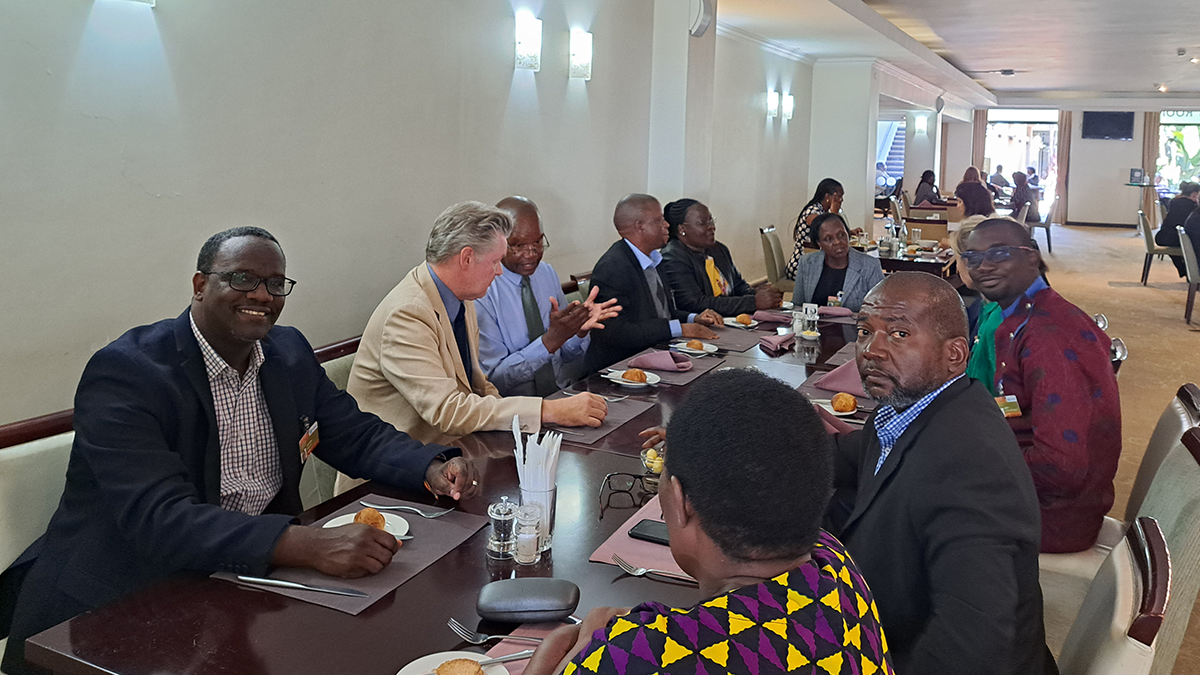
Between 20th – 22nd September 2022, Raymond Mutura, Director, Centre for Research on Organizations, Work and Family (CROWF) participated in a stakeholders’ workshop to discuss policies addressing older persons, the family and intergenerational relations in sub-Saharan Africa. This workshop was organized by the United Nations under the Department of Economic and Social Affair (UNDESA), Division for Inclusive Social Development.
In his presentation, titled: Family Businesses as an Avenue for Supporting Older Persons, Raymond emphasized the policy issue as follows: the economy plays a significant role in advancing the welfare of the family. Whilst the country realizes economic growth and development, the positive effects trickle down to the families.
In times of high inflation, unemployment and macroeconomic instabilities, savings are wiped out and incomes are therefore depleted. This puts a lot of strains on families and deviant tendencies are likely to emerge as individuals look for coping mechanisms. Economic planning should therefore be done with the family’s wellbeing in mind so that strategies devised work to advance the welfare of families for a stronger society. (This is as indicated in the Draft National Policy on Family Promotion and Protection – Thematic Area: Economy).
He highlighted the following as key challenges:
- African economies are primarily driven by Micro, Small and Medium Enterprises (MSMEs), many of which are family owned. The challenge is that MSMEs are not fully supported, mainly because they lack the proper business structures.
- Lethargy in government (mainly politicians) to focus on the development of the people as opposed to money-oriented projects – NGOs and other governments with this mindset deter true development through taking advantage of this mindset. The root of this is corruption which leads to poverty
- There is lack of empirical research to see intergenerational connections
Under solutions, Raymond proposed the following interventions:
- Get National Policy on Family Promotion and Protection in Kenya approved. Cascade this to the rest of E.Africa.
- Through efforts such as Technical Working Groups(TWGs), academia is being forged together. This can aid in generating a State of the Family Report (as recommended in our Family policy) every 5 years and that this should be a critical report for the country.
- TWGs to catalyze and invite the private sector to support the policies developed. One way is to work around advisory services by older members that may include marriage/parenting counseling /advisory.
About the Centre for Research on Organizations, Work and Family
The Center for Research on Organizations, Work and Family (CROWF) is a research institution within Strathmore Business School that has the task of developing strategies that help organizations in Kenya improve employee retention, commitment and personality through enabling employee engagement.
By using the practical output gained from various activities and collaborations (e.g. with PFD, Government of Kenya, Executive Education and Family Scholars Colloquia, to assist and engage persons, families and companies see the connection on how the family enables work, organizations, businesses and society in general to thrive by conducting and disseminating research on this. Learn more about the Centre for Research on Organizations, Work and Family here
Article by Juliet Hinga
Would you like to share an article? Write to us at sbscommunication@strathmore.edu
Share This Story, Choose Your Platform!
Your journey to business excellence starts here. Subscribe today and be at the forefront of innovation and leadership.






 English (United States)
  English (UK)
  French