

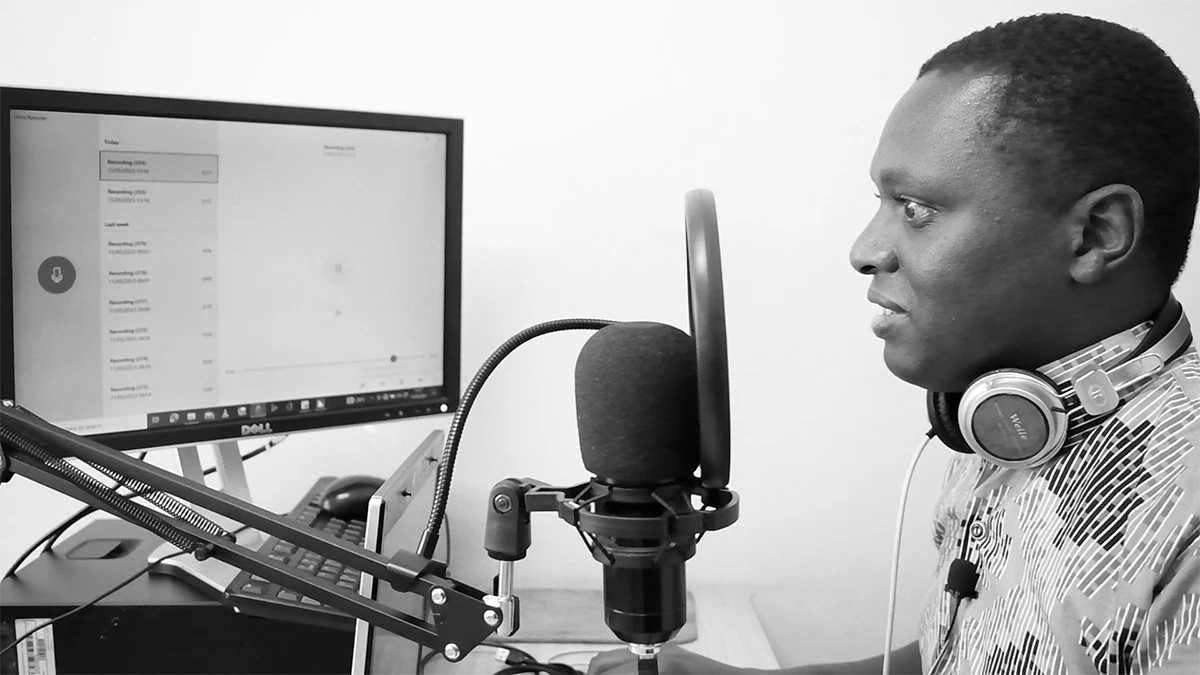
Moses Chiira’s story is a living testament to the truth in Dieter F. Uchtdorf’s words: “It’s your reaction to adversity, not adversity itself that determines how your life’s story will develop.” Moses, the founder of Vuka Sheriffs Limited, has built a thriving career in audio production, voiceovers, broadcasting, and tender supply. But his path to success was far from easy, particularly in the challenging context of being visually impaired in Kenya.
In Kenya, individuals with visual impairments face significant barriers to education, employment, and social inclusion. According to the Kenya National Bureau of Statistics, approximately 250,000 Kenyans live with visual impairment. Access to essential services, including education and healthcare, remains a challenge due to societal stigma, inadequate infrastructure, and limited resources. Many visually impaired individuals struggle to secure formal employment, with the unemployment rate among persons with disabilities (PWDs) being disproportionately high compared to the national average.
The stigma surrounding disability, especially visual impairment, often leads to social exclusion. Many visually impaired individuals are isolated, lacking opportunities to engage with their communities or pursue their ambitions. The public transport system, for instance, is rarely accessible to those with visual impairments, further compounding their isolation. Additionally, access to assistive technologies, such as screen readers or Braille materials, is limited, especially in rural areas, making education and communication even more difficult.
The Kenyan government, through the National Council for Persons with Disabilities (NCPWD), has made strides in addressing these challenges. The introduction of the Disability Smart Card, which provides PWDs with access to various statutory benefits and services, is a step towards inclusion. However, the issuance of these cards has been slow, and many PWDs, including Moses, have faced delays in receiving the card, which is crucial for accessing support services.
In 2016, Moses’s life took a dramatic turn when he lost his sight. What could have been a devastating blow instead became the beginning of an incredible journey. Rather than succumbing to despair, Moses embraced rehabilitation, learning mobility skills, mastering Braille, and familiarizing himself with adaptive technology. His dream of becoming a radio journalist never wavered, and he pursued a diploma in radio production, eventually landing an attachment at a vernacular radio station. There, his distinctive voice caught the attention of a presenter, who trained him as the voice of the station for six months.
However, the onset of the Covid-19 pandemic brought unforeseen challenges. Moses was laid off, and the stability he had built seemed to crumble. But in this dark moment, Moses saw an opportunity to forge his own path. He decided to start his own company, Vuka Sheriffs Limited. Yet, the road to entrepreneurship was rocky. Some clients refused to pay for his services, citing his visual impairment as a reason. Discouraged and nearly ready to give up, Moses reached a turning point when he enrolled in the Entrepreneurship Accelerator Programme for Persons with Disabilities at Strathmore University Business School.
“Participating in the Entrepreneurship Accelerator Programme at Strathmore University Business School became a turning point for me,” Moses recalls. The program not only equipped him with essential business skills but also helped him overcome the barriers that had been holding him back. “I learned the significance of paperwork, contracts, and financial management. This newfound knowledge enabled me to establish a solid foundation for my company.”
One of the most transformative aspects of the program was its focus on digital marketing. Armed with this knowledge, Moses set up a WhatsApp business account to showcase his work, leading to new opportunities, including podcast projects and brand representation. His coach’s advice to maintain focus and pursue his passion, rather than viewing it solely as a business venture, resonated deeply with him.
Moses’s story is a remarkable example of resilience, education, and the power of a supportive community. His success not only defies the societal norms that often sideline visually impaired individuals but also challenges the broader perceptions of what PWDs can achieve. Despite his visual impairment, he has not only overcome his challenges but has also found success in an industry he loves.
His journey serves as a powerful inspiration, proving that determination, skill development, and embracing opportunities can lead to extraordinary achievements. Moreover, it highlights the critical importance of programs like the Entrepreneurship Accelerator Programme, which provide PWDs with the tools and knowledge they need to break free from societal limitations and pursue their ambitions.
In a country where access to resources and opportunities for visually impaired individuals remains limited, Moses’s story stands as a beacon of hope. It underscores the need for continued advocacy, improved access to assistive technologies, and the creation of more inclusive environments that empower PWDs to thrive. Moses’s journey is not just about personal success; it is a call to action for society to dismantle the barriers that hinder the full participation of visually impaired individuals in all aspects of life.
Article by Juliet Hinga
Share This Story, Choose Your Platform!
Your journey to business excellence starts here. Subscribe today and be at the forefront of innovation and leadership.







 English (United States)
  English (UK)
  French