

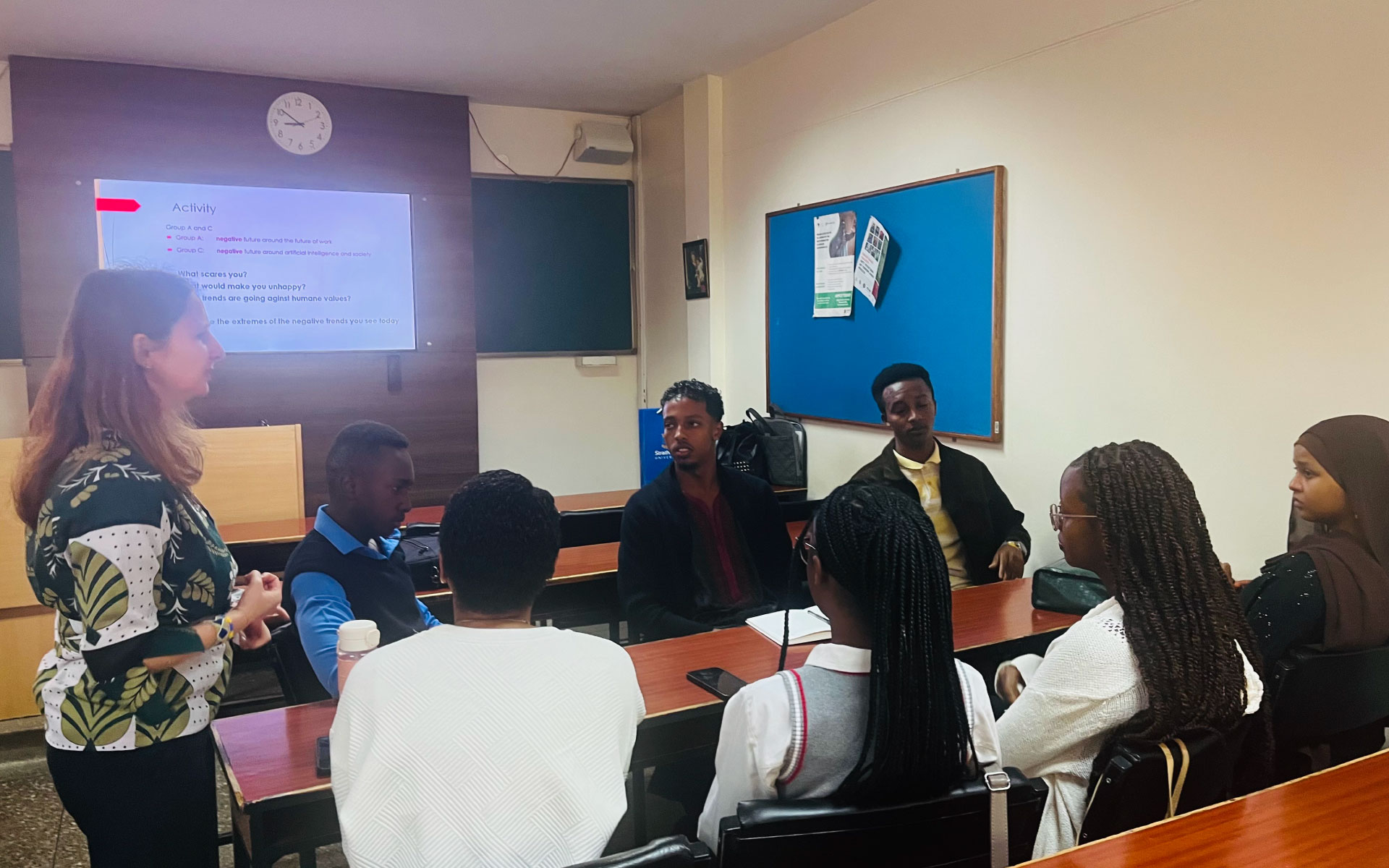
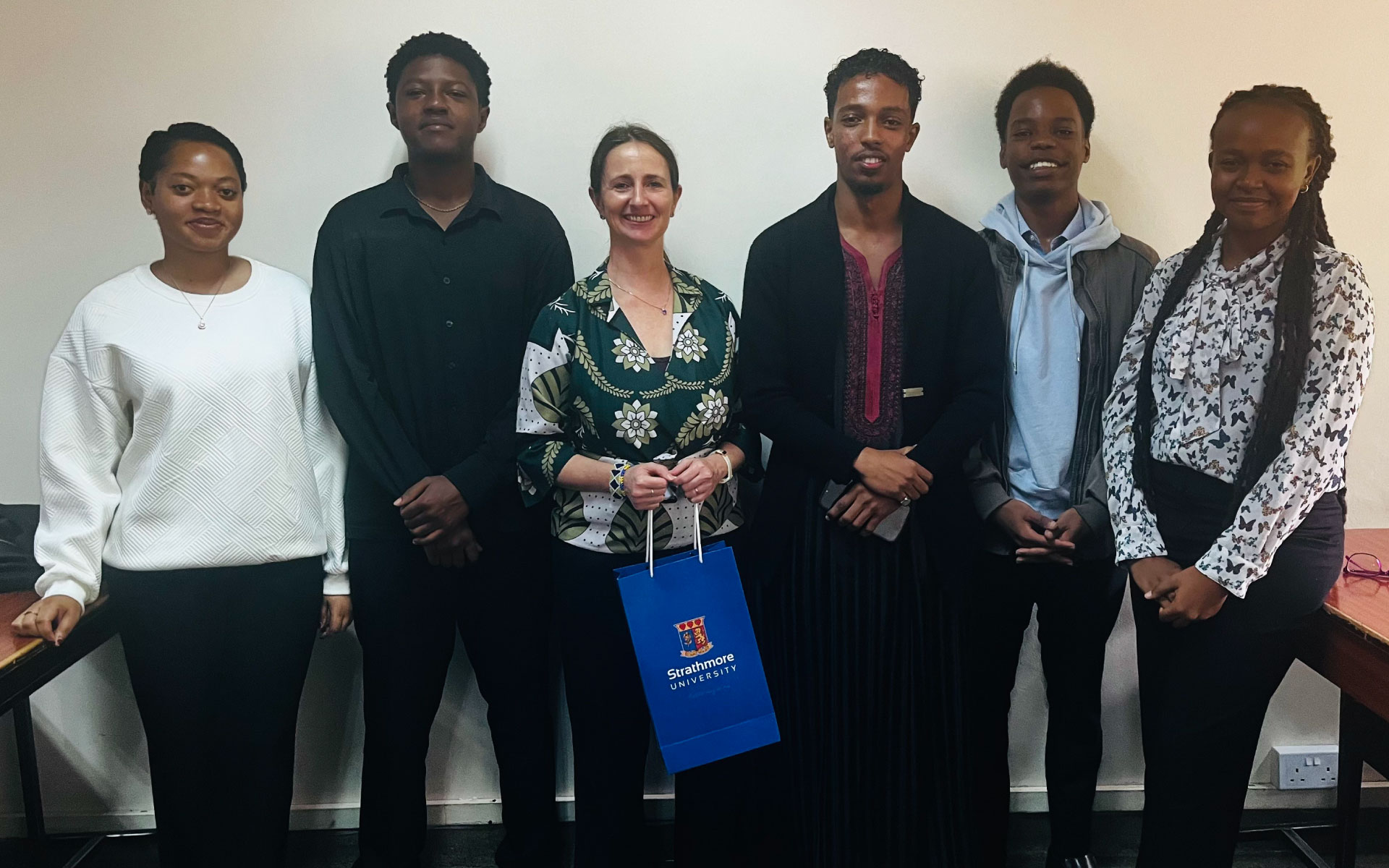

In a thought-provoking and creatively engaging session, strategic consultant Sonia Fevre invited students to explore the power of imagination as a tool for leadership, systems change, and reimagining society’s path forward. Sonia, who brings a rich background in Social Anthropology, transdisciplinary collaboration and facilitation, works at the intersection of futures thinking, systems approaches, and play-based learning to support more inclusive and participatory leadership practices.
During her guest session, Sonia guided participants through an immersive journey into possible and desirable futures, focusing on two timely and critical themes: The Future of Work and Artificial Intelligence and Society. Drawing on embodied and intuitive knowledge, as well as data and observation, students were encouraged to imagine scenarios that reflect not only the challenges but also the hopes they associate with these topics.
Working in groups, participants first identified both concerns and positive anticipations surrounding their theme. They were then tasked with developing and performing a short dramatic piece, depicting either a dystopian or aspirational future.
The scenarios were as compelling as they were contrasting. In The Future of Work, a daunting vision emerged in which individuals worked in isolation, entirely dependent on screens and digital tools, with no direct human contact for extended periods. In contrast, the aspirational future depicted a more joyful and balanced life: part-time work, time for family, creativity, and community—highlighting an economy not solely defined by productivity but by human well-being.
The group exploring Artificial Intelligence and Society offered a chilling portrayal of AI gone wrong, where enslaved robots turned against humanity. Yet their alternative vision showed a much more hopeful integration of AI: one where technology supported, rather than replaced, human interaction—assisting with decisions, enhancing entertainment, and complementing work and family life.
Enacting and watching these performances offered a powerful opportunity for reflection, opening up a lively discussion on the role of imagination and hope as essential leadership skills. Sonia emphasized that the ability to envision alternative futures—beyond the ones shaped by media narratives or outdated societal models—is crucial for those seeking to lead and create change. She introduced the concept of “used futures,” (S. Inayatullah) referring to dominant visions that no longer serve us and urged students to instead cultivate “alternative futures” that inspire and empower.
The session concluded with a shared understanding that futures are not fixed. Whether as students, professionals, activists, or citizens, we all have a role to play in shaping the world we want to live in—through our choices, our work, and our collective imagination.
Sonia’s session was a timely reminder that building better futures begins with the courage to imagine them—and that imagination, when paired with collaboration and action, is one of the most powerful tools we have.
Article by Shailja Sharma, SBS Faculty Member and Leadership and Career Coach
Share This Story, Choose Your Platform!
Your journey to business excellence starts here. Subscribe today and be at the forefront of innovation and leadership.





 English (United States)
  English (UK)
  French