

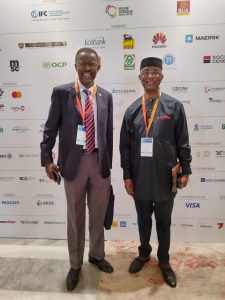
Themed from 300 to 3,000, the Africa CEO Forum, held on 5th and 6th June 2023 in Abidjan, Ivory Coast, brought together more than 2,000 African business leaders to discuss how the continent can create champions of transformation in the continent.
The forum featured scintillating discussions on the critical role that public and private sectors play in fostering high-performing African multinationals through government strategies, partnerships, and regional value chains.
It is evident that in order to achieve sustainable transformation, Africa needs to grow its economic potential through increased business growth. Today, Africa has nearly 300 companies with turnovers exceeding $1bn, compared to 2,700 in Europe and 3,300 in Asia.
How can Africa grow from 300 to 3,000?
One thing is clear, a prepared talent pool for the future will be a critical factor in propelling Africa’s growth. To address this issue, the forum brought together leaders of educational institutions and business leaders to discuss innovative ways of future-proofing the supply of exceptional local talent in a session dubbed; In the Dean’s Office: Shaping African Talent to Meet Future Private Sector Needs.
As African corporations embrace digitalization, becoming more intricate and globally competitive, the challenge of acquiring skilled professionals has become a prominent concern for CEOs. Globally, CEOs and CHROs complain about a scarcity of talented individuals, leading to increased expectations for higher education institutions to prepare the upcoming generation with practical proficiencies including, technological and financial literacy, business acumen, and AI expertise.
According to a 2018 Report by the International Finance Corporation (IFC) on Shaping the Future of Africa, Africa’s working-age population will increase by 1.7 million monthly until 2030, the highest in the developing regions. Further, 50 per cent of the global population growth between 2022 and 2050 will be in Africa. This growing labour force is expected to supercharge economic growth making Africa the world’s future workforce.
One of the key highlights from the session was the paradox of Africa’s workforce shortage. It was noted that out that 4 in 5 African organisations were affected negatively by a lack of skills in the past year. Due to this lack of skills, 46 per cent of organisations could not effectively meet client’s needs, 53 per cent suffered a reduced innovation rate and a further 60 per cent lost customers.
The discussion further highlighted Artificial Intelligence, Adaptable skills, Growth Mindset, Leadership, Robotics, and soft skills (Agility, Emotional intelligence, empathy etc) as the most sought-after skills.
Speaking during the forum, Dr. Caesar Mwangi, the Executive Dean, of Strathmore University Business School, pointed out that institutions have to be intentional about inculcating value systems in the learning process if the continent is to benefit from graduates. In addition, he intimated that business schools and universities should be at the forefront in informing the kind of interventions that organizations need to take to be successful. This is by actively engaging in research work to inform these interventions but also skills gaps.
Prof. Chris Ogbechie, Dean, of Lagos Business School, noted the need to grow more institutions in Africa that are driving the value systems conversation. He further opined that a mindset shift was necessary for how to approach education. In many African countries, education has been left to the government in terms of policy decisions, funding, and the structure of running programs. He proposed a multi-stakeholder involvement approach and ownership of the education process, with the private sector playing a key role to partner with government and development partners to inform market relevance in the kind of programs universities offer.
The session also brought to the fore some key areas for executives to pay keen attention to, including empathy, leadership and ethics, and digital transformation given the fast-paced changes in the operating environment. Education institutions have a role to play in creating programmes that continue to hone the skills of executives, making them more competitive.
Lastly, the session underscored the importance of taking care of educators, who are pivotal in developing Future-ready learners. As such the government and other stakeholders need to create an enabling environment for educators by providing adequate pay, research, and innovation capacity and creating opportunities for faculty collaborations.
The journey to 3,000 will require a prepared Africa, and this means a talent-proof Africa! This requires an appreciation of the most relevant skills for the future, adopting a multi-stakeholder approach to ensure we meet the skills gap, ensuring that educators are not only supported but provided an enabling environment, and making sure that business leaders continue to hone their skills.
Article by Shadrack Mwagangi, Director, Executive Education at Strathmore University Business School
Would you like to share an article? Write to us at sbscommunication@strathmore.edu
Share This Story, Choose Your Platform!
Your journey to business excellence starts here. Subscribe today and be at the forefront of innovation and leadership.







 English (United States)
  English (UK)
  French