

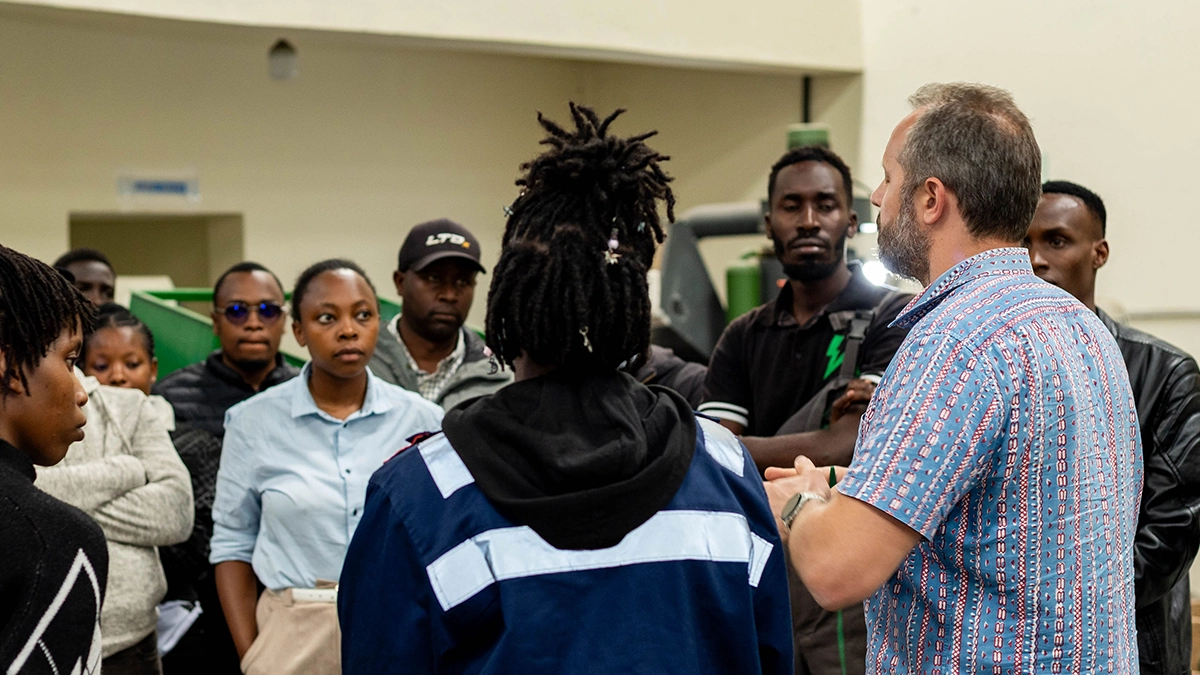
On Thursday, 18 June 2026, researchers, policymakers and practitioners gathered for a Business and Peace Roundtable to examine a question that is gaining urgency across East Africa: how can the private sector, from multinational firms to informal cross-border traders, become a genuine partner in building peace, rather than an unwitting driver of conflict?
The Business and Peace Working Group (BPWG) is a research and policy-oriented partnership between Aston Business School, Strathmore Business School, Creative Alternative Now and Inter-peace that seeks to translate academic and policy evidence of the vital role that businesses, financial institutions, social enterprises and SMEs play in peacebuilding into practical interventions. Focusing on the Horn of Africa, particularly on the Ethiopia-Kenya-Somalia border areas, as well as the Democratic Republic of Congo (DRC) and South Sudan, the conference sought inputs from participants on what conditions, through which strategies, with what safeguards and for whose benefit businesses contribute to peacebuilding in East Africa through employment, trade, finance, supply chains, procurement, community investment and conflict-sensitive operating practices.
In partnership with Strathmore University and hosted by the Strathmore University Nonprofits, Social Enterprises and Philanthropy (SUNSEP) Hub at the Strathmore Business School, the one-day event brought together peace and business practitioners. The moderated discussions were guided by a briefing and consultation paper that highlighted the role that businesses in East Africa play in supporting peace through local trust, livelihoods, and market connectivity; identified risks including reinforcing conflict economies and exclusion; and proposed effective strategies such as community engagement, conflict-sensitive practices, and regulation, especially in fragile contexts. The objective of the roundtable was to brainstorm next steps, including developing operational guidance, assessing the impacts of peace, and fostering partnerships to embed peacebuilding in business practices.
The session opened with introductions from Dr William Murithi, a senior faculty member at Strathmore Business School, who was a co-convener and Lead of the SUNSEP Hub and Dr Bahar Ali Kazmi, a senior faculty member at Aston University, who set the scene with a short briefing on the policy brief framing the day’s discussion. Additionally, the roundtable was attended by representatives from the National Cohesion and Integration Commission, Jane Kamau, Mohamed Dahir, Aurealia Phosa and Joy Atogot, Peter Oloo, the founder of Social Enterprise Society of Kenya, and chair for Climate Change at KEPSA, Catherine Masolia, CEO SOMO, Christine Buesser, a leading consultant in international development, Khalif Kobane, Country Director, Windle Somalia, Mohamed Abulrizak, founder of Agents for Peace, among others.
Participants then worked through three guiding questions in a roundtable format, surfacing insights from lived experience across Kenya, Somalia, the Democratic Republic of Congo and the wider region. The roundtable sought to answer three questions,
Question 1: Which businesses are best placed to build peace?
Moderated by Dr Bahar, the first session asked which forms of business engagement- SMEs, social enterprises and informal trade hold the strongest potential to support peacebuilding in East Africa.
The discussions highlighted the role of young people in the peacebuilding process through enterprise. Participants noted that where youth lack relevant 21st-century skills and economic opportunity, they become more vulnerable to recruitment into conflict; conversely, those with a stake in their community’s prosperity are more invested in peace. Online recruitment, it was noted, increasingly targets tech-savvy young people, making digital literacy and youth-focused enterprise both a vulnerability and an opportunity. One example raised was Green World Youth, a youth-led tree-seedling initiative cited as a model for building shared purpose.
Social enterprises were described as attractive vehicles for peacebuilding because they sit at the intersection of social integration and economic survival, and because conflict drivers such as poverty and resource competition are embedded directly in the communities they serve. The point was reinforced by reference to international frameworks, including the SDGs 8, 10, 16, and 17; the UN Peacebuilding Fund; and the UN Youth, Peace and Security agenda, all of which recognise social enterprise as a peacebuilding tool. The Mkenya Daima initiative, launched after Kenya’s 2008 post-election violence, was cited as a precedent for multi-stakeholder business engagement during periods of instability.
Participants were candid about the limits of the social enterprise model: without a viable revenue base, high tax burdens and minimal incentives mean such ventures struggle to survive. Efforts by the Social Enterprise Society of Kenya to mobilise stakeholders and draft a clear legal definition for social enterprises, comparing approaches in Thailand, the UK, South Korea and France, were highlighted as necessary groundwork, since Kenya’s existing PBO Act, Cooperatives Act and NGO Act each define the space differently.
Informal cross-border trade also featured prominently. Border communities where women often dominate trade were described as building relational ties that persist even when formal borders close, with mobile and digital platforms helping sustain those connections. Supporting these traders through microfinance and encouraging their organisation into cooperatives and business associations was identified as a practical, scalable intervention. Notably, participants observed that the majority of SMEs in Somalia are led by women, and that most local peacebuilders are also older women, yet a persistent gap remains between these women and political decision-makers.
The session closed without a single consensus answer. Some argued that social enterprise is the strongest candidate, provided it is paired with genuine diversity and inclusion; others suggested the conversation should shift toward SMEs, since they are better understood as economically viable actors with a longer track record. All agreed that cross-border trade has real potential for scaling, and that the field is still in its early stages of identifying which models matter most.
Question 2: Safeguarding business activity from becoming a conflict driver
Moderated by Dr William Murithi, the second session asked what safeguards and conflict-sensitive practices are needed to ensure business activity strengthens peace rather than reinforcing exclusion, grievance or climate-related risk.
Cultural sensitivity emerged as a recurring theme, from dress codes and hiring practices to the distribution of CSR programmes across communities. Participants stressed that businesses must seek community consensus before acting; skipping that step, however time-consuming, was seen as a direct path to misunderstanding and conflict. Equally important was recognising informal community leadership structures, not just official ones, since a business that fails to secure buy-in from informal leaders can find its initiatives actively resisted.
Grievance mechanisms were discussed at length. The case of Kakuma refugee camp was raised, where traders alleged discriminatory policing compared to host-community businesses, an example of how unaddressed grievance can itself become a driver of conflict. Participants argued that businesses perceived as extractive attract resentment, while those that visibly distribute wealth and opportunity earn social license to operate. Practical examples included coastal cooperatives sourcing local products, such as bar soap, for the hotel industry, demonstrating that supporting local businesses can be sound commercial practice, not just goodwill.
Several structural risks were flagged, including ethical lapses, unhealthy competition, climate risk, and supply chain exploitation. Business ethics issues, such as allegations of child labour on tea farms and labour displacement from mechanisation, were identified. Unhealthy competition, including concerns about Chinese imports affecting traders in areas like Eastleigh, and weak intellectual property protections: participants cited cases of Kenyan products being copied and resold regionally, and cultural property such as Maasai shuka designs being copyrighted abroad – create tensions between local communities and businesses that are perceived to be of foreign origin. Climate risk, addressed through initiatives such as Kenya’s National Climate Change Action Plan and green-jobs partnerships (for example, Mastercard and DANIDA-funded programs), reflects growing recognition that climate adaptation and peacebuilding agendas must be integrated. Supply chain exploitation, particularly when smallholder farmers, such as those in coffee value chains, lack the ability to integrate vertically and capture more value, creates resentment between producers and other actors higher up in the supply chain.
Participants also pointed to public-private partnership models, citing the Kenya Private Sector Alliance and Impact Investment Kenya as mechanisms for bridging government policy with private investment, alongside calls to integrate early warning and early response (EWER) data-sharing with the business community so that problems can be addressed before they escalate. Where state security mechanisms are weak, it was noted, businesses often end up self-policing, directly putting them into conflict with some members of the local community.
The session closed on a clear principle: policies must have practical, not just symbolic, implications. Equality provisions, such as gender employment quotas, mean little without enforcement, and businesses that embed the common good and shared value into their operating models are best positioned to support peace rather than undermine it.
Question 3 (What are the possible challenges and outcomes we can expect?) and closing reflections
The third planned question on practical tools, training, partnerships and policy dialogues was introduced, but discussion ran out of time before it could be fully explored, leaving it as an area for follow-up work.
In the closing session, moderated by Faisa and Victoria Gichuki (SUNSEP Hub), participants reflected on the need to think more deeply about context. Existing peacebuilding frameworks, several noted, are often not designed with the specific people and backgrounds they are meant to serve in mind, a gap that matters given Africa’s national and subnational diversity. The dominant takeaway was that peacebuilding requires synergy: no single actor, government, business, or community can carry it out alone. Participants agreed that the field remains in its early stages of understanding precisely how business can contribute to peace, including the risks, opportunities and recommendations that should guide future practice.
Next steps
The roundtable concluded with a call to action for participants: to submit feedback from the discussion; contribute to forthcoming policy briefings; join the Business and Peace Working Group; and translate insights into practical work and resource mobilisation. Participants were also left with a personal challenge to carry forward: what change will you bring about after this consultation?
Written by Kennedy Wangari, a Volunteer at SUNSEP, and an International Relations Student at Strathmore University
Share This Story, Choose Your Platform!
Your journey to business excellence starts here. Subscribe today and be at the forefront of innovation and leadership.






 English (United States)
  English (UK)
  French