


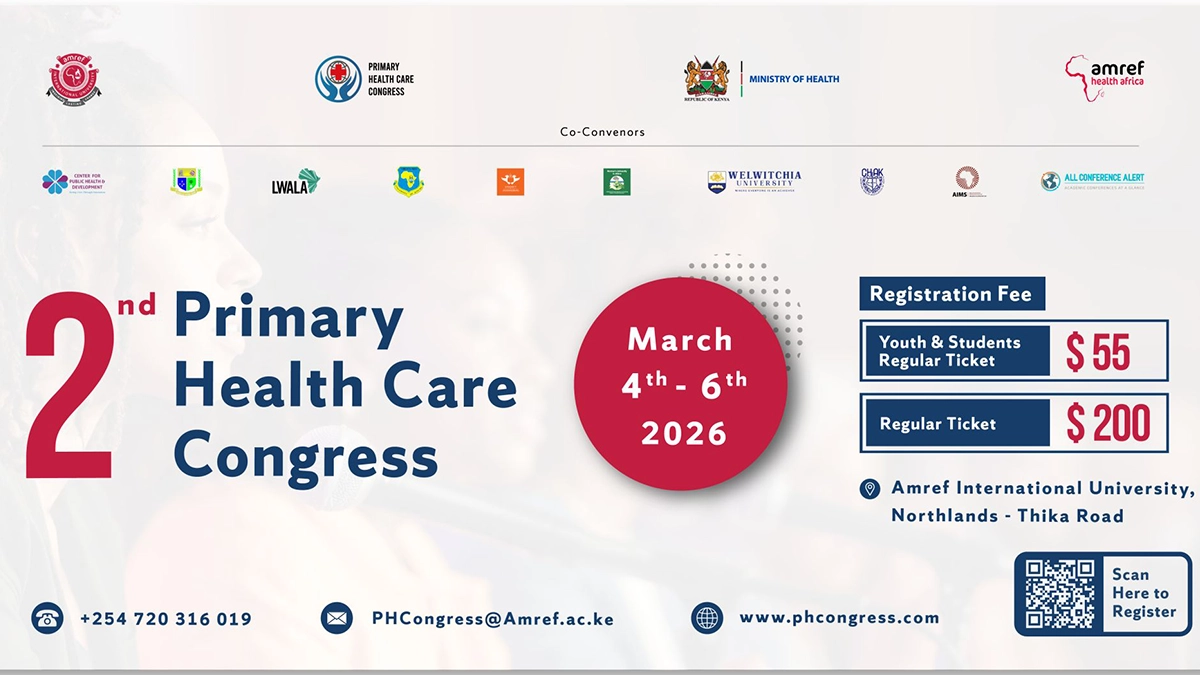
When Gladys Kamau – Juma, a PhD candidate at the Strathmore Business School (SBS), walked into the 2nd Primary Healthcare Congress in Nairobi, she went as a researcher. She left different: a scholar whose work had been validated, stretched, and electrified by three days of encounter with the most pressing questions in African health systems today.
“Eye-opening and appetizing” is how Gladys described the experience — and it is a description that captures something important, not just about this Congress, but about what happens when doctoral researchers step out of the library and into the living, contested spaces where their research matters.
Held from 4–6 March 2026, the Congress was organised by Amref International University in collaboration with the University of Johannesburg, Women’s University in Africa, Welwitschia University, Great Lakes University of Kisumu, and Jaramogi Oginga Odinga University of Science and Technology. It convened policymakers, heads of diplomatic missions, community health actors, primary care practitioners, academics, development partners, and the private sector — all under the theme “Redesigning Primary Health Care: Building Resilience Amidst Global Uncertainty.”
The programme was substantial: four plenary sessions, 18 panel discussions, 118 oral abstract presentations, and six poster presentations, supported by 16 exhibition booths. Across two days, substantive debates ranged across health financing reforms, digital transformation of the primary healthcare workforce, community-based health models, and Kenya’s landmark legislative agenda — the Primary Health Care Act, Digital Health Act, Facility Improvement Financing Act, and Social Health Insurance Act — as a regional blueprint for systemic change.
“When PHC is weak, the whole system crumbles.” — Ms. Mary Muthoni Muriuki, CBS, Principal Secretary, State Department for Public Health and Professional Standards
For Gladys, the Congress did not simply provide general exposure to the health sector — it spoke directly to the questions at the heart of her doctoral research. Hearing those themes debated by policymakers, implementers, and practitioners from across the continent gave her work a new dimension: not just confirmation that her research area is relevant, but a sharper sense of where the gaps lie, where the field is moving, and where a well-placed doctoral contribution could make a genuine difference.
Gladys’ experience is a useful prompt for a wider reflection. “As a doctoral student, this Congress was particularly beneficial as it highlighted the gaps between policy reforms and implementation in primary healthcare facilities, sparking great ideas for my research. The emphasis on multisectoral partnerships and political commitment also aligned with my interest in exploring governance models that enhance primary healthcare accessibility and resilience in the future.”
For health systems researchers, there is no substitute for the kind of knowledge that only surfaces in a room full of practitioners: the implementation challenges that rarely make it into journal articles, the political dynamics behind policy decisions, the quiet innovations happening at the community level that the literature has not yet caught up with. These are the textures that give doctoral research its grip on reality — and they are the textures that Gladys encountered at the Congress in abundance.
Conferences also offer something harder to name but no less important: the experience of belonging to a field. Meeting peers from partner universities across Africa, hearing from Dr. Githinji Gitahi of Amref Health Africa that community-based health systems are the most effective pathway to Universal Health Coverage, or listening to Prof. Joachim Osur of Amref International University affirm that universities must generate the evidence that drives primary healthcare policy — these moments remind a doctoral student that their work is part of something larger. That sense of scholarly community sustains the long, often invisible labour of a PhD in ways that no single supervisor or reading list can.
Article by: Judith Adhiambo Amolo & Gladys Kamau – Juma
Share This Story, Choose Your Platform!
Your journey to business excellence starts here. Subscribe today and be at the forefront of innovation and leadership.






 English (United States)
  English (UK)
  French